Why Test Hormones?
Hormone health is complex. Hormones function as an interconnected system, influencing metabolism, energy, mood, sleep, reproductive function, body composition, stress response, and many other aspects of health. Changes in one hormone or pathway can influence others, and hormone production naturally changes throughout life.
For practitioners evaluating hormone health or managing hormone replacement therapy, hormone levels are only part of the picture. How hormones are metabolized can be equally important. Measuring parent hormones together with their downstream metabolites can provide a more complete view of hormone production, metabolism, and the pathways through which hormones are being processed.
Testing replaces assumptions with objective information. It can help establish a baseline, identify patterns that warrant attention, guide a more informed approach to hormone support, and provide a way to monitor changes over time.
More Than 25 Years of Experience in Urine Hormone Testing
Meridian Valley Laboratory pioneered commercial urine hormone testing for practitioner use more than four decades ago. That experience continues today with advanced 24-hour urine hormone assessment designed to capture hormone production and metabolism across an entire day rather than at a single moment in time.
Our comprehensive PRISM24™ assessment provides an integrated view of the hormone landscape, while PACE24™ offers a focused assessment well suited for targeted evaluation and ongoing monitoring.
Behind every result is more than a laboratory measurement. Meridian Valley Laboratory combines decades of hormone-testing experience, thoughtful reporting, educational resources, and access to experienced Consulting Physicians who help practitioners understand the patterns within their patients’ results and translate that information into informed patient management.
Measure the hormones. Understand the pathways. See the bigger picture.
|
Women: Common Symptoms |
Estrogen | Progesterone | Thyroid | Glucocorticoids | DHEA | Testosterone | GrowthHormone | Melatonin | Oxytocin |
| Hot flashes | ✓ | ✓ | |||||||
| Night sweats | ✓ | ✓ | ✓ | ||||||
| Headaches | ✓ | ✓ | ✓ | ✓ | ✓ | ||||
| Hair loss | ✓ | ✓ | ✓ | ✓ | |||||
| Poor sleep | ✓ | ✓ | ✓ | ✓ | ✓ | ||||
| Anxiety | ✓ | ✓ | ✓ | ✓ | ✓ | ✓ | ✓ | ||
| Depression | ✓ | ✓ | ✓ | ✓ | ✓ | ✓ | ✓ | ✓ | ✓ |
| Stress | ✓ | ✓ | ✓ | ✓ | ✓ | ✓ | ✓ | ✓ | ✓ |
| Low libido | ✓ | ✓ | ✓ | ✓ | ✓ | ✓ | ✓ | ||
| Memory lapse | ✓ | ✓ | ✓ | ✓ | |||||
| Sugar cravings | ✓ | ✓ | ✓ | ✓ | |||||
| Weight gain | ✓ | ✓ | ✓ | ✓ | ✓ | ✓ | ✓ | ✓ | ✓ |
| Increased facial hair/acne | ✓ | ✓ | ✓ |
|
Men: Common Symptoms |
Estrogen | Progesterone | Thyroid | Glucocorticoids | DHEA | Testosterone | GrowthHormone | Melatonin | Oxytocin |
| Poor stamina | ✓ | ✓ | ✓ | ✓ | ✓ | ||||
| Decreased muscle mass/strength | ✓ | ✓ | ✓ | ||||||
| Neck/back pain | ✓ | ||||||||
| Low libido | ✓ | ||||||||
| Decreased erections | ✓ | ✓ | ✓ | ✓ | ✓ | ||||
| Sugar cravings | ✓ | ✓ | |||||||
| Weight gain | ✓ | ✓ | ✓ | ✓ | ✓ | ✓ | ✓ | ||
| Stress | ✓ | ✓ | ✓ | ✓ | ✓ | ✓ | ✓ | ||
| Apathy/burned out feeling | ✓ | ✓ | ✓ | ✓ | ✓ | ✓ | |||
| Anxiety | ✓ | ✓ | ✓ | ✓ | ✓ | ✓ | |||
| Depression | ✓ | ✓ | ✓ | ✓ | ✓ | ✓ | ✓ | ||
| Poor Cognition | ✓ | ✓ | ✓ | ✓ | ✓ | ✓ | |||
| Memory lapse | ✓ | ✓ | ✓ | ✓ | ✓ | ✓ |
Why 24-Hour Urine Hormone Testing?
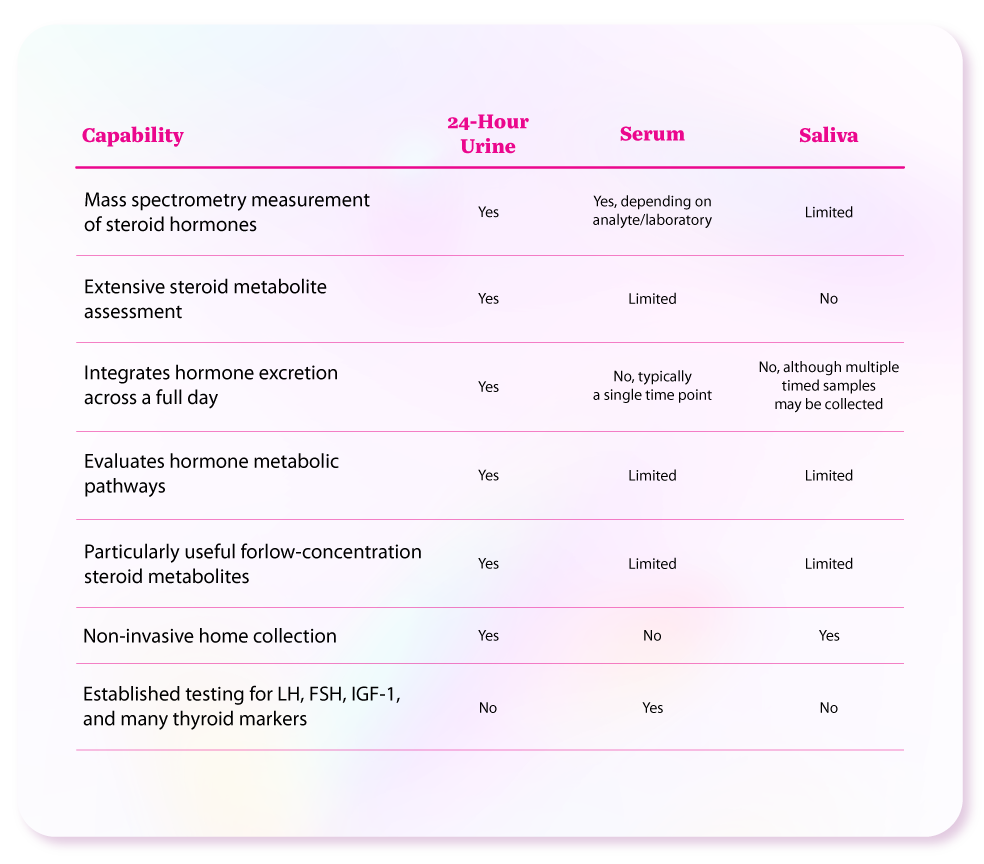
No single specimen type answers every hormone-related question. Serum, saliva, and urine each provide different information. The value of 24-hour urine hormone testing is its ability to combine measurement of hormone production with extensive assessment of hormone metabolism while integrating hormone excretion across an entire day.
See More Than the Parent Hormone
Using highly sensitive mass spectrometry methods, 24-hour urine testing can measure parent hormones together with many of their downstream metabolites.
These metabolites provide information that cannot be obtained by simply measuring estradiol, testosterone, progesterone, or cortisol alone. They can reveal how hormones are being metabolized through pathways involving estrogen hydroxylation and methylation, androgen metabolism, and cortisol/cortisone metabolism.
Understanding these pathways can provide important additional context when evaluating hormone physiology and monitoring hormone replacement therapy.
Capture an Entire Day
Hormone production is dynamic. Concentrations can change with circadian rhythms, sleep and waking, activity, stress, meals, and episodic or pulsatile secretion.
A blood draw or single-catch urine specimen represents one moment in time. A properly collected 24-hour urine specimen integrates hormone and metabolite excretion across the entire collection period, reducing the influence of short-term fluctuations and providing a broader perspective on daily hormone production and metabolism.
Measure Hormones That Are Difficult to Assess in Blood
Many steroid hormone metabolites circulate at very low concentrations but are concentrated through urinary excretion. Urine therefore provides an excellent matrix for measuring a broad spectrum of steroid metabolites and examining relationships among parent hormones and their metabolic products.
This expanded view is particularly valuable when the question is not simply “How much hormone is present?” but also “What is happening to that hormone after it is produced or administered?”
The Right Specimen for the Right Question
24-Hour Urine
Best suited for comprehensive assessment of steroid hormone production and metabolism, including estrogens, androgens, progestins, corticosteroids, and their metabolites. It provides an integrated full-day measurement and is collected non-invasively at home.
Serum
Remains the preferred or established specimen for many endocrine measurements, including LH, FSH, IGF-1, insulin, thyroid markers, and other peptide and protein hormones. Serum is also appropriate when a circulating hormone concentration at a defined point in time is the information needed.
Saliva
Measures selected free hormones and can be useful when multiple timed collections are desired, particularly for examining the daily pattern of cortisol. Its narrower analyte range and dependence on collection conditions make it less suited to comprehensive steroid metabolite assessment.
Understanding Hormone Testing Specimens
A More Complete View of Steroid Hormone Physiology
For steroid hormone assessment, concentration is only part of the story. Production, metabolism, clearance, and the relationships among hormones and their metabolites can all contribute meaningful information.
24-hour urine testing brings those pieces together, providing practitioners with a broader view of the hormone landscape and better information for informed patient management.
Meridian Valley Lab was the first commercial laboratory to develop urine hormone testing for clinical practice. With a 40+ year track-record of providing reliable, clinically useful results, we are your best choice for hormone testing that will give you the information you need to improve your patients’ hormonal health while reducing potential hormone-related risks. Our association with Dr. Jonathan Wright and contracted Physicians allows us to observe the relationship between lab results and clinical outcomes. Our Consulting Physicians are unmatched in providing consultations that are both educational and immediately actionable.
Testing Options

24 Hour Urine Hormone Profiles
Assess up to 35 primary hormones, metabolites, and plus calculated values and ratios, collected over a full 24-hour period for comprehensive insight.

Complement your hormone testing with targeted serum panels for adrenal rhythm, thyroid function, and nutrient-linked blood changes affecting mood and metabolism.